


One of the most influential sculptors active in Los Angeles in the 1960s and ’70s, De Wain Valentine is perhaps best known for his large-scale polyester resin sculptures of simple geometric forms that interact intensely with the surrounding light. Not as well known, however, are the huge challenges he faced in finding a material that would allow him to realize his artistic vision. He pushed artistic boundaries, creating a new polyester resin that allowed him to make luminous sculptures of monumental proportions.
Last week, as part of Pacific Standard Time, the artist discussed those challenges and boundaries at “An Evening with De Wain Valentine,” presented by the Getty Conservation Institute and the Getty Research Institute. The evening began with a screening of a documentary on De Wain’s work.
De Wain told the packed crowd about his love affair with the light and sea and the sky in Los Angeles, his struggle to create monumental artworks with polyester resin, the lasting friendships he forged with other artists of the era such as Dan Flavin and Frank Gehry (see that discussion here), and the ongoing tension between conserving his artwork in a way that represents his vision but still leaves the handmade “soul” of the piece—the subject of this clip.
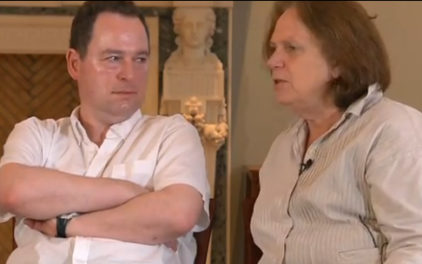
De Wain spoke with senior scientist Tom Learner, who curated the exhibition From Start to Finish: De Wain Valentine’s Gray Column (through March 11), centered on the 1975–6 sculpture Gray Column, which, at twelve feet high, eight feet across, and about 3,500 lbs, is one of the largest artworks De Wain ever made with polyester resin. Pacific Standard Time: Crosscurrents in L.A. Painting and Sculpture, 1950–1970 (through February 5) also includes a piece by De Wain, the eight-foot-high Red Concave Circle, one of my personal favorites.
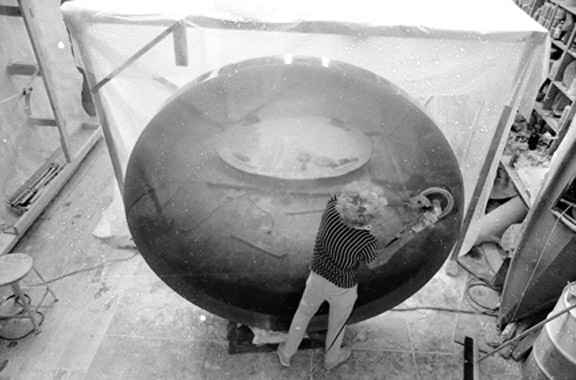
De Wain Valentine polishing one of his eight-foot-diameter polyester Circles in his Venice studio in the late 1960s. Image © Harry Drinkwater


Comments on this post are now closed.