


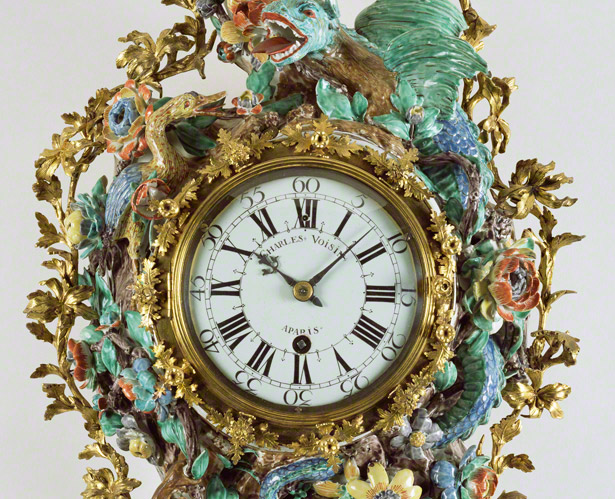
Wall Clock (Pendule d’alcove), about 1740, movement by Charles Voisin, clockmaker; clock case made at the Chantilly Porcelain Manufactory. Soft-paste porcelain; gilt bronze; enameled metal; glass. 2 ft. 5 1/2 in. high. The J. Paul Getty Museum, 81.DB.81
Each time daylight savings time comes and goes, the punctually minded among us rush to wheel the hands of our analog clocks back or forward one hour. No such fussing is needed for the clocks in the Museum’s collection, which hold court in the Getty Center’s South Pavilion along with the furniture, paneled rooms, tapestries, and other treasures from our decorative arts collection.
That’s because, for these clocks, time stands eternally still. Their delicate mechanisms would be damaged by perpetual movement, so their hands remain fixed—meaning they tell time correctly only twice a day. And for most of these clocks, that time is 10:10 (give or take a few).
Why 10:10? This placement of hands is widely agreed to be “the perfect display time for a clock,” according to Charissa Bremer-David, our expert in French decorative arts. “If you look at advertisements, from Timex to Rolex, the clock hands are usually at 10 after 10.” This time not only displays the hands to best advantage (and highlights the clockmaker’s logo), but actually makes it seem like the clock is smiling. Which I like to think our clocks really do, when you take a minute to admire them.

Wall Clock, about 1710, attributed to André-Charles Boulle. Gilt bronze veneered with blue painted horn and brass; enameled metal; glass. 2 ft. 4 in. high. The J. Paul Getty Museum, 73.DB.74

Mantel Clock, about 1790–1800, movement by Nicolas-Alexandre Folin, clockmaker; enamel plaques by Georges-Adrien Merlet, enameler. Gilt bronze; enameled metal; white marble; glass. 1 ft. 6 in. high. The J. Paul Getty Museum, 72.DB.57
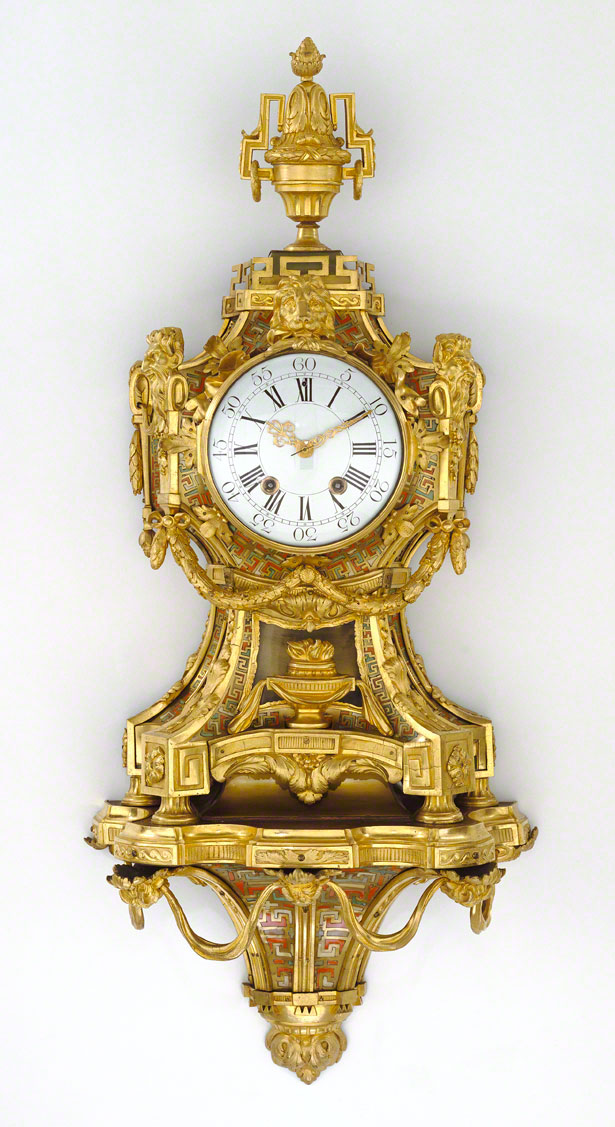
Wall Clock on Bracket, about 1764, case and bracket stamped by Antoine Foullet, furniture worker; movement by Lapina, clockmaker. Oak veneered with red-, green-, and cream-painted horn and brass; enameled metal; gilt bronze. 3 ft. 10 3/4 in. high. The J. Paul Getty Museum, 75.DB.7


What a treat to see the riotous “flora and fauna” porcelain clock – one of my favorites!
Annelisa,
I agree with Amra. The Chantilly Porcelain Manufactory clock is the one that speaks to me. If you stand in front of it long enough, the creatures start peering out, one by one … omg – it’s “Jumanji”!