


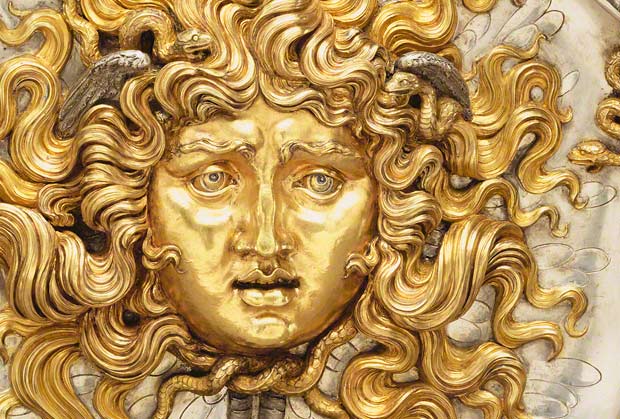
She’ll turn you to stone! Medusa, 1911, Vincenzo Gemito. Parcel-gilt silver
What’s spookier than a terrible monster with snakes growing out of her head who can turn you to stone with just one look?
Maybe it’s an invisible ghost who returns from the dead to haunt his wife. Or a sea monster who lures sailors to their deaths by pretending to be an island, then swimming away when they step onto his back.
These and other scary stories await you at Art Scoops, a new online feature for kids, families, and teachers that provides the scoop on dozens of works of art from the collection of the J. Paul Getty Museum. Each Art Scoop is a quick look into a story behind the work of art for parents and kids to explore together. They’re divided into categories: Stylish, Fresh, Spooky, Magical, Kooky, Colorful, Fancy, and Lucky.
The “Spooky” category provides plenty of Halloween thrills, including a devilish horned sculpture and a bug with pinching jaws as big as its body and an appetite for blood.
While Art Scoops is fun, it’s also educational—the goal is to get parents and kids to look closely at art objects together. “It’s written to be accessible and fun and to encourage interactions within the family,” Elizabeth Escamilla, who leads our K–12 programs at the Getty Center, told me. “It’s a great resource for families to spark interest and curiosity before a visit to the Getty.”
Although Art Scoops is primarily intended as a resource for parents, who serve as children’s first teachers, it’s useful in the classroom as well. “We hope teachers will integrate this resource into lessons,” Elizabeth said.
And here’s a tip: As a reader of the Spooky Art Scoops, you’ll know more grisly facts more than most visitors to the Museum. “We’ve included some surprises, and some information you won’t find in the wall text or the audio guides,” Elizabeth revealed. “This is the real inside scoop.”
To get the scoop, visit Art Scoops here.
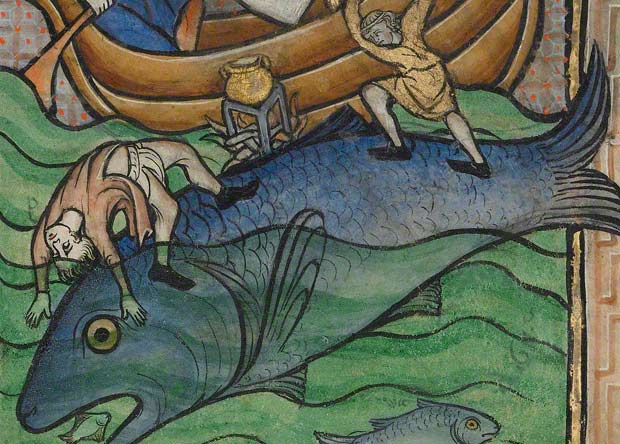
Meet the fearsome sea creature known as the aspidochelone in Two Fishermen on a Sea Creature, about 1270, Franco-Flemish


That Medusa may be classed as ‘spooky’ but I find it slightly beautiful apart from the expression on the face, which conveys a feeling of daze to me. I love the fish though. A print of this would make a color addition to any bathroom, love the artistry of it.
We also have a “spooky” plant in the bowl garden this month, a Nightshade plant. Green grotesque leaves with orange spikes growing from them, and tiny purple flowers– it sort of creepy. And it always blooms around Halloween.
Deborah — I know just the plant you mean! I think it’s Porcupine Tomato (Solanum pyracanthum) — super-Halloweeny! –Annelisa
Annelisa, yes that is the plant. Kids love that one. Great photo and now I have the real name.